
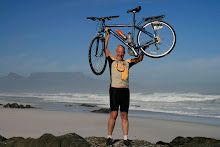
For our first 6 days in Namibia, we saw a daily continuation of the violent electrical storms that we experienced in Botswana. It’s been raining virtually non-stop.
Perhaps my impression of the storms is embellished, because, for the most part, we have only the skins of our tents and our raincoats as our main sources of protection. My tent is soaking wet, my clothes musty and my sleeping bag damp.
We rode three days from Windhoek to Sessriem, with legs of only 115, 125 and 83 kms.
These distances pale by comparison to those done in the last few legs. However, there were some ‘mitigating’ factors about which you are about to learn, that made these days more than a little formidable.
My sister Bev, before I left to join the Tour reassured me about the roads in Namibia.
“Bill, the particular roads that you will be travelling on in Namibia are all gravel from Windhoek to the South African border. But you don’t have to worry – they’re the best gravel roads in the world.”
Perhaps roads look different from the seat of a bicycle compared to those seen from the comfort of an air-conditioned expedition vehicle.
Bev could have said, “…gravel and sand.” But she didn’t. She left it for me to discover the sand.
Sand – the kind of sand that takes 10 kph off your average ground level speed.
Sand – the kind of sand that makes climbing hills much more difficult.
Sand – the kind of sand that makes you moderate your downhill speed. If you don’t slow down – you will skid and crash. Four riders spilled on the downhills. One separated a rib cartilage and another bent her front wheel rim.
Sand – the kind of sand that makes your upper body struggle and strain to keep the front wheel from twisting.
Sand – you know – the kind of sand that this mornings rain has turned to mud.
And then there are the road corrugations. I know all about corrugations, but my memory of them was embedded in some dormant part of my brain. Within the first metre of hitting the gravel road, I remembered the corrugations, recalling past encounters.
Think about it – all gravel roads are corrugated - three corrugations per metre.
OK – grandchildren – Kate, Lucy, Willem and Ander – it’s time a mathematics test……….
If there are 3 corrugations in every metre of ground travelled, and if there are 1000 metres per kilometre, how many corrugations are there in 1 kilometre?
Mmmm – let’s see? 3 x 1000 = 3000. You’re right. That’s how many corrugations you hit each kilometre. That’s how often your shoulders get jarred – not to mention the bum hits!
Some days you have choices to make – ride the thick sand next to the car ruts or ride the corrugations.
Corné, riding the corrugations is a little like horse riding. If you are slow, it’s like trotting. Every corrugation sends a jarring jolt up your spine. But if you can increase the speed a bit, it is a little like cantering. It’s less bumpy as you round off the tops of the ridges, but it’s difficult to maintain. That, however, is where the comparison ends. When you ride a horse, the horse does most of the work. When you ride a bike, you do all the work!
The 115 km ride from Windhoek to our first southern bush-camp took me as long to ride as did my now famous 207 forays done on my 71st birthday.
First, it took me two hours to climb the first 24 kms into the hills south of Windhoek. Looking back, it’s a beautiful city embedded in mountains and valleys. We had headwinds coming into Windhoek and we had headwinds leaving. It doesn’t get its name for no reason. ‘Windhoek’ translated means ‘windy corner’!
Next, once up in the plateau, and for a considerable time, I could not get my speed up above 5 kph, what with the sand, the mud and the headwinds.
Then began about twenty ‘rolling hills’ before camp.
‘Rolling hills’ are synonymous with zero net elevation gain or loss. One rides up one hill, down the next valley only to repeat this zero gain game over and over. Whilst there is no gain or loss of altitude, there is a gradual and progressive drain in the body’s energy systems.
Remember, climbing the hills makes you strong, and riding the flat makes you fit!
On our second day south of Windhoek, as I climbed Spreetshoogte Pass, I thought of you Michael.
“Bill, you can’t lift a 1000 pound weight, but you can lift a one pound weight 1000 times. It’s like that when riding the hills.”
So, as I geared down to my lowest gear and grinded it out, your advice brought me comfort. By the way, tell Maria that I’m loading up on carbs theses days!
Reaching the bottom of the Pass, we faced headwinds all the way to camp – headwinds, rain and mud – and throw in a few rolling hills for good measure. For about 40 minutes I was caught up on the edge of one of these monster storms. Rolling claps of thunder and torrents of rain followed each bolt of lightning. It was one of my most difficult days.
I witnessed a most remarkable display of both horizontal sheet lighting strikes as well as the more common vertical ground strikes.
Sheet lightening happens when one cloud discharges its electrical current into an adjacent less charged cloud. Ground lightening happens when a cloud’s electricity is discharged to the ground. Sheet lightening endangers aircraft. Ground lightening endangers buildings and humans.
Our third day south of Windhoek, a mere 83 kms, began like so many other recent rides – in another electrical storm!
Sessriem, on the edge of the famous Namibian dunes in the Namib desert, saw the end of the storms as we had known them for the past two weeks, but the ground was moist, the potholes brimming. They had received rain the night before we arrived.
My choice of bicycle proved to be excellent, whereas my choice of tyres was poor. As some of you know, I toyed with the idea of riding a bamboo bike. But we had some major problems with it before I left, and Marty and Jim urged me to take my steel Specialized bike with the 29-inch tyres. It was a good decision.
Jessica and Lianne did ride through Zambia with bamboo bikes. Whilst they completed their rides in good form, they were not without significant challenges.
I took two sets of tyres – a narrow Armadillo set and a broader flat top – lateral lug type.
I took the Armadillo’s for two reasons. They would give me faster speeds on the paved roads of Zambia, Botswana and South Africa. Also, they market this tyre as the toughest on the road.
The problem was that ‘paved’ roads in Africa aren’t always as suspected. The road from Lusaka to Victoria Falls is heavily potholed and there are at least 4 road construction detours. The ‘paved’ roads in Botswana consist, for the most part, of tar impregnated crushed rock. It’s anything but smooth. The Armadillo’s got me about 100 kms into Botswana before being discarded, along with their reputation for toughness, into a refuse bin. They were no match for these roads. The broader tyres fared even worse. They got ditched in Maun, riddled with holes. I borrowed tyres from fellow riders to get me to Windhoek where I got some sturdy all-purpose Namibian tyres. So far, gravel and sand notwithstanding, they are holding up well.
Our day off saw us go for a 5-hour day trip to the famous dunes.
On our safari van were Annalise, investment banker from Australia, Cat the corporate lawyer from New York, Katia, a business consultant from South Africa, Jim, a lawyer from Portland, Oregon, Michael the British Medical Student. His lip is healing beautifully. What a great group of people and what a magnificent day. I know now why photo enthusiasts like Bev rave about Namibia.
Next, we have 5 riding days to Felix Unite on the Namibian – South African border.
Don’t worry folks – we’ll be riding on the best-maintained gravel roads in the world!!!
As Glynn would say, “It’s all good, I’m loving it!”
Saturday, May 8, 2010


Monday, May 3, 2010
Sossusvlei in the Namib desert
Can't post a full blog folks because internet is too skimpy. Will post two from Felix Unite on the Namibia South Africa border in 5 days time................
Thursday, April 29, 2010

Maun, Botswana to Windhoek, Namibia
Maun, Botswana to Windhoek, Namibia – 836 kms in 5 days, with legs of 168, 140, 207, 162 and 159 kms.
Foreheads dripping, tongues slaked, this week we rode the Kalahari. Not as you might imagine in the sweltering heat. Unexpectedly, we rode in the rain. At some point in all of our 9 days in normally very arid Botswana we had moments of rain. For the last 5 days right up to the Namibian border we encountered torrential rains amidst lightning and thunder. These weren’t your typical short-lived African thunder bursts. Some of the storms lasted for 6 to 8 hours at a time. For three nights as we attempted to sleep in our flimsy tents, we were entertained by very close bolts of lightning followed by thunderous rolling claps of sound, each round of thunder releasing more drenching rain. By timing the interval between light and sound, I could tell if the storms were advancing or retreating. Awaking in the morning, we found that one camper, having failed to find high ground for his tent, was flooded. He abandoned his tent for a bench in the support truck. Rivulets ran hither and yon.
On my 71st birthday I rode 207 kms. Not only was this the longest single day’s ride for the Tour since leaving Cairo, but it was also a personal best for me – the longest one day ride I have ever done in my life!
I usually ride alone, but on this auspicious day, Cat elected to chaperone me on my journey. She is a fabulous person - a litigation lawyer from New York. As we rode we solved many of the world’s problems. It took us over 50 kms to review the history of South Africa from Chaka to Zuma, with key references to Churchill, Rhodes, Smuts and Mandela. We discussed the legal and political implications of the recent financial meltdown where Cat was involved in a very significant way, and we began the redesign of health care for 2020.
On this 207 km day we rode the first 80 and the last 20 in the rain. In between we saw storm cells to each side as they swirled about. As a cell passed, we faced the advancing head wind from the clockwise vortex only to be swept on the other side by the storm’s tail wind. This day ended at the Namibian border. For the last two kilometres the large rain droplets turned to quarter inch balls of ice.
Hail – in Botswana – it was hard to believe!
I’ve learned something about physical fitness that I never knew before. It’s probably ‘old hat’ to many of my athletic friends, but it was a new discovery for me. Advance training for this Tour in the Canadian winter allowed 5 or 6 days a week in the gym with various weight and spinning options. Then, on joining the Tour in full flight, I found myself riding 6 to 10 hour days. After 13 riding days from Lilongwe to Maun, my legs were painful and stiff.
Then, to my surprise, on this leg to Windhoek, I seemed to rediscover my rugby legs of yesteryear. I have some stiffness after a long ride, but no longer are my muscles painful.
The discovery is that one has to do a very considerable amount of forced exercise before breaking through to a new level of fitness – not one’s everyday experience of a few days in the gym or a few short bike rides.
Eastern Zambia was surprisingly hilly. Botswana, as advertised, was flat. There were hills as we approached Windhoek.
As one rider said, “the hills make you strong because of the work of climbing. But, it is the flat that makes you fit. All you do is pedal endlessly all day long.”
I’ve come to know most of the riders quite well now – too many to name them all. I’ll post a photo series later. They are a fun and fascinating group.
Guess who took the Okavango delta air flight with me? – Jessica and Lianne.
Guess the elevation of Windhoek? – 800 metres above Maun – it was a steady and relentless climb, with headwinds and rain.
Guess the universal language that unifies all races in Namibia? – Afrikaans.
I have a confession to make. I had hoped to write more about all of the thoughts and ideas that go through my head each day as I ride along, but come the end of the day, all I can do is pitch my tent, eat supper and hit the sack at 7 pm (1900 hours, as they say in Zambia)!
Breakfast is at 6 am and we’re on the road by 6.30.
It’s rather redeeming to have one’s life reduced to a tent and a bicycle!
Foreheads dripping, tongues slaked, this week we rode the Kalahari. Not as you might imagine in the sweltering heat. Unexpectedly, we rode in the rain. At some point in all of our 9 days in normally very arid Botswana we had moments of rain. For the last 5 days right up to the Namibian border we encountered torrential rains amidst lightning and thunder. These weren’t your typical short-lived African thunder bursts. Some of the storms lasted for 6 to 8 hours at a time. For three nights as we attempted to sleep in our flimsy tents, we were entertained by very close bolts of lightning followed by thunderous rolling claps of sound, each round of thunder releasing more drenching rain. By timing the interval between light and sound, I could tell if the storms were advancing or retreating. Awaking in the morning, we found that one camper, having failed to find high ground for his tent, was flooded. He abandoned his tent for a bench in the support truck. Rivulets ran hither and yon.
On my 71st birthday I rode 207 kms. Not only was this the longest single day’s ride for the Tour since leaving Cairo, but it was also a personal best for me – the longest one day ride I have ever done in my life!
I usually ride alone, but on this auspicious day, Cat elected to chaperone me on my journey. She is a fabulous person - a litigation lawyer from New York. As we rode we solved many of the world’s problems. It took us over 50 kms to review the history of South Africa from Chaka to Zuma, with key references to Churchill, Rhodes, Smuts and Mandela. We discussed the legal and political implications of the recent financial meltdown where Cat was involved in a very significant way, and we began the redesign of health care for 2020.
On this 207 km day we rode the first 80 and the last 20 in the rain. In between we saw storm cells to each side as they swirled about. As a cell passed, we faced the advancing head wind from the clockwise vortex only to be swept on the other side by the storm’s tail wind. This day ended at the Namibian border. For the last two kilometres the large rain droplets turned to quarter inch balls of ice.
Hail – in Botswana – it was hard to believe!
I’ve learned something about physical fitness that I never knew before. It’s probably ‘old hat’ to many of my athletic friends, but it was a new discovery for me. Advance training for this Tour in the Canadian winter allowed 5 or 6 days a week in the gym with various weight and spinning options. Then, on joining the Tour in full flight, I found myself riding 6 to 10 hour days. After 13 riding days from Lilongwe to Maun, my legs were painful and stiff.
Then, to my surprise, on this leg to Windhoek, I seemed to rediscover my rugby legs of yesteryear. I have some stiffness after a long ride, but no longer are my muscles painful.
The discovery is that one has to do a very considerable amount of forced exercise before breaking through to a new level of fitness – not one’s everyday experience of a few days in the gym or a few short bike rides.
Eastern Zambia was surprisingly hilly. Botswana, as advertised, was flat. There were hills as we approached Windhoek.
As one rider said, “the hills make you strong because of the work of climbing. But, it is the flat that makes you fit. All you do is pedal endlessly all day long.”
I’ve come to know most of the riders quite well now – too many to name them all. I’ll post a photo series later. They are a fun and fascinating group.
Guess who took the Okavango delta air flight with me? – Jessica and Lianne.
Guess the elevation of Windhoek? – 800 metres above Maun – it was a steady and relentless climb, with headwinds and rain.
Guess the universal language that unifies all races in Namibia? – Afrikaans.
I have a confession to make. I had hoped to write more about all of the thoughts and ideas that go through my head each day as I ride along, but come the end of the day, all I can do is pitch my tent, eat supper and hit the sack at 7 pm (1900 hours, as they say in Zambia)!
Breakfast is at 6 am and we’re on the road by 6.30.
It’s rather redeeming to have one’s life reduced to a tent and a bicycle!
Friday, April 23, 2010

Victoria Falls, Zambia to Maun, Botswana
Victoria Falls, Zambia to Maun, Botswana – 680 kms in 5 days.
I am missing my two travel mates, Jessica and Lianne. They sent their bikes back to Lusaka, rode the lunch truck with us across the Botswana border, took the Chobe river cruise with the Tour riders, before bussing on to Gaborone to see Lani, a friend from UBC Okanagan.
On the river cruise we saw elephants, hippos, a lion, Marabou storks, fish eagles, hammerkops, crocodiles, monitor lizards, kudus and more.
As we broke camp leaving Kasani in northern Botswana, we were told that we may see game along the road.
As usual, at the start of each day, the riders and racers spread out quite quickly.
On this day as we rode, Carol and Andra found themselves surrounded by a large pack of wild dogs who seemed very interested in them. The dogs circled and bayed.
Fortunately for the riders, a car approached from the rear, saw their dilemma and rode behind them for about 10 minutes. The dogs finally broke off and left, disappointed that their morning ‘meal’ was denied!
Many of us saw giraffe on the road. Patrick and Wayne saw elephants.
As I rode, alone, I saw an oncoming car flashing his lights on and off as he passed. A few moments later a safari game-viewing vehicle stopped me to advise that I was to be cautious. There was a herd of Buffalo on the roadside ahead. With that warning, he sped on his merry way. As I crested a small hill, looking down, I saw a dozen Cape Buffalo grazing on the left side of the road. About twenty feet from the road, watching vigilantly over his herd, stood the alpha male, menacing and mean. I know that the buffalo and the hippo are amongst the most unpredictable and dangerous animals on the planet. My first instinct was to look for calves – there were none. Calves would make the herd hyper-vigilant and potentially more dangerous.
Some years ago, whilst camping at a Provincial Park in British Columbia, a game warden came to advise campers that grizzly bears were in the neighbourhood. We should stay in camp if possible. If we did leave, we were to go in groups. In the unlikely and unpleasant …sic… situation that we did encounter a bear, we should stand upright and face him directly. We should raise our arms to look greater than life, and we should scream loudly. That was one’s only line of defence.
As I cycled down towards the herd and the watchful bull, I realized that my ‘grizzly bear’ moment had come. I pedalled to get maximum speed. As I approached him, I stood up and faced sideways, waving wildly, and screaming ‘yeahhhhhhhhh’.
The bull looked up, saw this strange apparition waving and shouting from moving cycle. He hesitated, and then, along with his herd, he bolted into the bush. If it hadn’t happened this way, I would not be posting this blog today!!
Reaching Maun on the edge of the Okavango delta, who of all people were there to meet me? Jessica and Lianne. They had borrowed Lani’s 4x4 and had come to join the Tour on our day off. We plan to take the flight over the delta today. Did you know that the Okavango and the Jordan are the only rivers in the world that do not enter an ocean? The Jordan with scant flow drains to the heavily salinated Dead Sea. The Okavango drains to the delta, the largest wetland in the world. The fact that it is not a saltpan is a testimony to the wonders of wetland regeneration of nature.
I’ve been riding now for 17 days, and my legs seem to get more painful and stiffer each day. The night’s rest before each ride doesn’t seem to allow me to fully recover. Apparently, this is what other riders felt early on when leaving Cairo. So……. I’ll just keep on pedalling, and maybe I’ll break through soon.
I am missing my two travel mates, Jessica and Lianne. They sent their bikes back to Lusaka, rode the lunch truck with us across the Botswana border, took the Chobe river cruise with the Tour riders, before bussing on to Gaborone to see Lani, a friend from UBC Okanagan.
On the river cruise we saw elephants, hippos, a lion, Marabou storks, fish eagles, hammerkops, crocodiles, monitor lizards, kudus and more.
As we broke camp leaving Kasani in northern Botswana, we were told that we may see game along the road.
As usual, at the start of each day, the riders and racers spread out quite quickly.
On this day as we rode, Carol and Andra found themselves surrounded by a large pack of wild dogs who seemed very interested in them. The dogs circled and bayed.
Fortunately for the riders, a car approached from the rear, saw their dilemma and rode behind them for about 10 minutes. The dogs finally broke off and left, disappointed that their morning ‘meal’ was denied!
Many of us saw giraffe on the road. Patrick and Wayne saw elephants.
As I rode, alone, I saw an oncoming car flashing his lights on and off as he passed. A few moments later a safari game-viewing vehicle stopped me to advise that I was to be cautious. There was a herd of Buffalo on the roadside ahead. With that warning, he sped on his merry way. As I crested a small hill, looking down, I saw a dozen Cape Buffalo grazing on the left side of the road. About twenty feet from the road, watching vigilantly over his herd, stood the alpha male, menacing and mean. I know that the buffalo and the hippo are amongst the most unpredictable and dangerous animals on the planet. My first instinct was to look for calves – there were none. Calves would make the herd hyper-vigilant and potentially more dangerous.
Some years ago, whilst camping at a Provincial Park in British Columbia, a game warden came to advise campers that grizzly bears were in the neighbourhood. We should stay in camp if possible. If we did leave, we were to go in groups. In the unlikely and unpleasant …sic… situation that we did encounter a bear, we should stand upright and face him directly. We should raise our arms to look greater than life, and we should scream loudly. That was one’s only line of defence.
As I cycled down towards the herd and the watchful bull, I realized that my ‘grizzly bear’ moment had come. I pedalled to get maximum speed. As I approached him, I stood up and faced sideways, waving wildly, and screaming ‘yeahhhhhhhhh’.
The bull looked up, saw this strange apparition waving and shouting from moving cycle. He hesitated, and then, along with his herd, he bolted into the bush. If it hadn’t happened this way, I would not be posting this blog today!!
Reaching Maun on the edge of the Okavango delta, who of all people were there to meet me? Jessica and Lianne. They had borrowed Lani’s 4x4 and had come to join the Tour on our day off. We plan to take the flight over the delta today. Did you know that the Okavango and the Jordan are the only rivers in the world that do not enter an ocean? The Jordan with scant flow drains to the heavily salinated Dead Sea. The Okavango drains to the delta, the largest wetland in the world. The fact that it is not a saltpan is a testimony to the wonders of wetland regeneration of nature.
I’ve been riding now for 17 days, and my legs seem to get more painful and stiffer each day. The night’s rest before each ride doesn’t seem to allow me to fully recover. Apparently, this is what other riders felt early on when leaving Cairo. So……. I’ll just keep on pedalling, and maybe I’ll break through soon.
Lianne..... 'Oh the Places you go...
Oh the Places You’ll Go…..
I think our experience as a part of Tour D’Afrique has been described by my two friends who have a beautiful vernacular, and therefore I will try to describe the experience from a humorous standpoint.
Firstly I would like to ask who thought I would be able to ride over 1000km in the African Sun??? Exactly…I didn’t either! But we all did it, and we did it gracefully. This time in Africa I have learned many things, but one of the most inspirational being the power of believing in oneself. The three of us really really wanted this bike ride and we trained and we rode hard….and the payout was the completion of a very difficult event. It goes to show that you really can do anything if you put your mind to it.
Secondly, I would love to express my passion for nursing. How we linked nursing with riding your bike across an African country is still mind boggling, but it has been done! I’ve enjoyed spending my time with the two nurses on the tour and learning the art of fluid replacement, rash management, and sadle soreology…..which I may or may not have been a patient of the later ailment.
Looking back it is hard to believe it is over. What is even more surprising is how much I am going to miss it. Who in their right mind would miss waking up at 5 am, packing up the tent again, and applying cream to a very sore bottom only to get on your bicycle to ride over 150km in the hot African sun? I do…and it makes me want to do it over again!
One of the finer memories from this trip was the noises you would hear at night…they were pretty much the typical African sounds, dogs barking, people dancing and playing music, and those darn roosters crowing all night. But wait….don’t those roosters belong to the tour staff?? On a few occasions the local staff who drove the support vehicles bought roosters to eat. However, they often took a few days to prepare the meals and riders patience would slowly be pushed as the roosters kept us up at all hours of the night.
Another favorite memory of mine was day 3 without running water…Not that bad, I know. But 3 days of riding your bike and producing more sweat than you ever have in your life and knowing you have to share a tent, that is a little more challenging. We were quite good at using the sun to “sterilize” your clothes and baby wipes to shower with. But on day 3 we stayed at a camp with a water pump. I will never forget the sheer joy on peoples face as people took turns inching themselves under the water pump for a shot of fresh skin sans salt!
On a serious note, I will truly miss the amazing food. Who would not love 4 solid meals a day with the portion sizes enough to feed a mother pregnant with triplets? The best part was the guilt free feeling that was accompanied by a hard day of riding. I am currently working on shrinking my stomach back down for my return home.
So in closing I want to express how much I have enjoyed the members of Tour D’Afrique, my fellow riders, and my two closest friends Bill and Jessica. I feel quite sad to know that this trip has come to an end, but on the positive side I am left with new outdoor enthusiast friends, stronger relations with my existing colleagues, and a deeper love for Zambia and it’s beautiful people.
I love biking. I love Zambia. I love these times of my life!
Kilimanjaro next year team?
Lianne
I think our experience as a part of Tour D’Afrique has been described by my two friends who have a beautiful vernacular, and therefore I will try to describe the experience from a humorous standpoint.
Firstly I would like to ask who thought I would be able to ride over 1000km in the African Sun??? Exactly…I didn’t either! But we all did it, and we did it gracefully. This time in Africa I have learned many things, but one of the most inspirational being the power of believing in oneself. The three of us really really wanted this bike ride and we trained and we rode hard….and the payout was the completion of a very difficult event. It goes to show that you really can do anything if you put your mind to it.
Secondly, I would love to express my passion for nursing. How we linked nursing with riding your bike across an African country is still mind boggling, but it has been done! I’ve enjoyed spending my time with the two nurses on the tour and learning the art of fluid replacement, rash management, and sadle soreology…..which I may or may not have been a patient of the later ailment.
Looking back it is hard to believe it is over. What is even more surprising is how much I am going to miss it. Who in their right mind would miss waking up at 5 am, packing up the tent again, and applying cream to a very sore bottom only to get on your bicycle to ride over 150km in the hot African sun? I do…and it makes me want to do it over again!
One of the finer memories from this trip was the noises you would hear at night…they were pretty much the typical African sounds, dogs barking, people dancing and playing music, and those darn roosters crowing all night. But wait….don’t those roosters belong to the tour staff?? On a few occasions the local staff who drove the support vehicles bought roosters to eat. However, they often took a few days to prepare the meals and riders patience would slowly be pushed as the roosters kept us up at all hours of the night.
Another favorite memory of mine was day 3 without running water…Not that bad, I know. But 3 days of riding your bike and producing more sweat than you ever have in your life and knowing you have to share a tent, that is a little more challenging. We were quite good at using the sun to “sterilize” your clothes and baby wipes to shower with. But on day 3 we stayed at a camp with a water pump. I will never forget the sheer joy on peoples face as people took turns inching themselves under the water pump for a shot of fresh skin sans salt!
On a serious note, I will truly miss the amazing food. Who would not love 4 solid meals a day with the portion sizes enough to feed a mother pregnant with triplets? The best part was the guilt free feeling that was accompanied by a hard day of riding. I am currently working on shrinking my stomach back down for my return home.
So in closing I want to express how much I have enjoyed the members of Tour D’Afrique, my fellow riders, and my two closest friends Bill and Jessica. I feel quite sad to know that this trip has come to an end, but on the positive side I am left with new outdoor enthusiast friends, stronger relations with my existing colleagues, and a deeper love for Zambia and it’s beautiful people.
I love biking. I love Zambia. I love these times of my life!
Kilimanjaro next year team?
Lianne
Subscribe to:
Posts (Atom)




 Posts
Posts

